

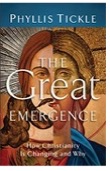
In her book The Great Emergence, Phyllis Tickle identifies the publication of Darwin’s Origin of the Species and Michael Faraday’s field theory as “without question, the line of demarcation between…”[1] the post-Reformation Church and the Church that is emerging now that the era of Christendom is over.
Darwin of course changed our understanding of what it means to be human, no longer were we made in the image of God but rather we are an accident of chemistry and subject to the impulses of evolution.
Faraday’s discovery of electromagnetic rotations and induction laid the basis for virtually all technology in the modern world. More fundamentally, and from a theological perspective, Faraday contended “that there was no ether and no matter, as physical substances. There were, instead, fields of forces like electricity and magnetism and gravity that, albeit unseen, girded everything. When and where the invisible lines of the force fields intersected, they created matter. So much for mystery and angels or spirits descending in light or as light. So much for leaving the invisible as too divine to tamper with. So much for thinking that everything that looked miraculous was.”[2] The important point to understand here is that as well as being an individual or private way of being and understanding, religion is also a social construct and is intimately connected to and affected by its environment.

A good way to understand this is to think of religion as a cable of meaning that tethers a group of people to a purpose or power higher than themselves in the same way a cable tethers a small boat to a dock.[3] The waterproof outer casing is the backstory, the shared history, mythical, actual, or assumed, of the group.
It is the ethos that all members share, that they hold unselfconsciously in common and by which they recognise one another as being alike. Beneath this “outer casing is a loosely knit mesh sleeve, that, because of its pliable construction, can give and take a bit as boat rocks on the waves outside. That sleeve…is the common agreement –again often unself-awaredly so – among members…about how the world works, about how it is to be…understood.”[4] Beneath that mesh are three strands braided together, spirituality, the experiences, and values internal to individuals, and morality, the enactment of those values and corporeality, the embodied evidence that religion exists.
Whilst Christianity formed the backstory of Western culture during the Christendom era, in a post-Christendom world, the cable has become untethered, and the internal cables have become untangled. Christianity no longer forms the backstory of culture and so our culture is no longer connected to the purpose and power that the Church was meant to bear witness to: the reality of God. The result has been that the church, like a boat cast adrift has moved from the centre of society to its margins.

A good way to grasp this shift from the centre to the margins is to consider the skyline of London. In 1746, on the eve of the Industrial Revolution the artist Canaletto painted London, the skyline of the city was dominated by St Paul’s Cathedral and the spires of dozens of churches throughout the city.

Theologian David Smith notes that, “More than two centuries later the dome of St. Paul’s remained as the outstanding landmark over the Thames and the City of London, but elsewhere new buildings rose to prominence which imitated the classic architecture previously used to signify the sacred, while in fact, they were monuments to industrial and scientific progress. John O’Connor’s 1881 painting of the Midland Grand Hotel, the crowning glory of Saint Pancras Station, exemplifies what Kostof calls the new ‘confusion of skyline priorities’. These buildings have been described as cathedrals celebrating money, technology, and innovation, ‘symbols of a new era of modernization and secularization, where glorification of the power of capital and promotion of industrialization went hand in glove with the rationalization of urban space and life’.[5]
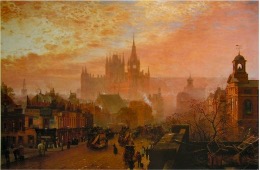
The shift in social, cultural status becomes even clearer when you consider the London skyline today; church spires no longer dominate the skyline, not even St Paul’s, but rather they are dwarfed by the gleaming glass temples of commerce and financial power where the gods of materialism and consumerism hold sway.
I suppose an appropriate question to ask at this point is so what? As a history lesson it might be interesting but why does it matter? The fact is that since the 1960’s there has been a steady, almost catastrophic decline in church membership. The Church has failed to understand the monumental cultural shifts occurring outside its doors and those shifts have all impacted the Church. Compounding this error, the Church has continued to operate based on a Christendom mind-set, as though nothing had changed. However, the reality is that we cannot reach a post-Christendom world using the ethos and methodology with which we operated during the Christendom era. However, there is cause for optimism.
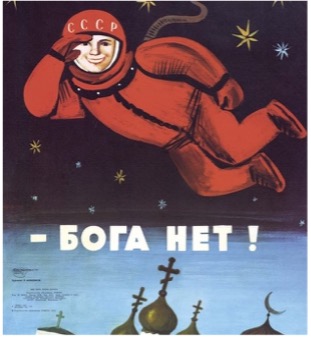
In his book Living with the Gods, historian Neil MacGregor explores the curious phenomenon of the rise of religion in the early 21st Century, it seems that not only is it stubbornly refusing to die out, but it is also actually growing globally. The old soviet poster of Gargarin in space looking for God, roughly translated this says there is no God, if anything, it is more out of step with today’s world than it was in 1961. The thing is that whilst more and more people are looking for God, they are not looking in the church.

The Church at Auvers was one of Van Gogh’s last paintings. It captures the reality we are in today. Notice there is no doorway into the church, the path goes around it. People are looking for God but there is no way into the church for them to find him, our task is to create entry points where they can encounter God. It is a long and painful process, but it can be done.
[1] Phyllis Tickle, The Great Emergence, (Grand Rapids: Baker Books, 2008), 65
[2] Phyllis Tickle, The Great Emergence, (Grand Rapids: Baker Books, 2008), 64f
[3] The illustration and metaphor are taken from Phyllis Tickle, The Great Emergence, 34-35
[4] Phyllis Tickle, The Great Emergence, (Grand Rapids: Baker Books, 2008), 35
[5] Maria Kaike and Korinna Thielen, ‘Form Follows Power: A Genealogy of Urban Shrines’, City, 110/1, April 2006, 59.