
Vincent Van Gogh is known as one of the world’s greatest artists, who famously went mad, cut his ear off, allegedly committed suicide and never sold a painting whilst he was alive. That short biography may or may not be true, but it misses the most important aspect of his art, namely his deep spiritual life that shaped and informed it. Vincent came from a family of preachers, and it was whilst working in an art gallery in London, Vincent felt the call to be a preacher, and his model was CH Spurgeon, a preacher he much admired.
He began formal theological studies but that did not work out for him, however, he became a missionary to the miners in the Borenage region of Belgium and his role there was shaped by two things. Firstly, he read and understood the Gospels in a very literal sense; secondly, he had an inexhaustible compassion for the poor amongst whom he was working.
The early Christians identified Jesus as the Suffering Servant spoken of in Isaiah who also called his followers to imitate his sacrificial suffering.There is no doubt that Vincent followed in that tradition and described his own mission as preaching the gospel to the poor.
There is no doubt that Vincent followed in that tradition and described his own mission as preaching the gospel to the poor. Like Christ, Vincent radically identified himself with the poor, he lived in a hut, gave away his salary, his clothes and his bed, and he did so because he saw Christ with these poor miners in their suffering. However, this approach to mission was not the sort of behaviour expected of those called to ministry in those times. In fact his father was deeply alarmed by Vincent’s approach, being concerned that Vincent had gone mad and tried to get him committed to a mental asylum. The missionary society was even more scandalised than his father, and so they rejected him and withdrew his position.
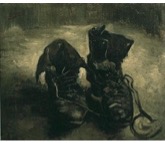
It was these events that led him to become a painter, saying that if he could not preach, he would paint, and every painting he did is, in a sense, a sermon. During his time in the Borenage, he discovered Christ in the poor, so he began to depict them in his art. Here we have a painting of a poor man’s working boots, nondescript and anonymous, symbolic of the poor workers, torn and worn like these boots. Vincent had decided that if he could not be an evangelist with a missionary society then he would be an evangelist through his art.
One of his most famous paintings is Starry Night, it is an autobiographical landscape that illustrates the three most significant ideas in Van Gogh’s art and life. The three segments within the painting of the village, the cypress tree and the sky represent three specific religious beliefs held by Van Gogh and capture the reality of being a Christian in today’s postmodern, post-Christian world.

In the village scene the church provides the focal point of the painting, however, Van Gogh paints the church in a rather curious way. The other buildings in the village glow with an inner light which reflects the brilliance of the starry sky, but the church remains completely dark. The church in Starry Night neither reflects the light of the evening stars nor emanates any light of its own. Some have suggested that the darkness of the church in Starry Night is for Van Gogh, symbolic of the empty and unenlightened preaching of the clergy that left him embittered and alone when he was forced to leave the ministry in 1880. Whilst that is possible, I think that this image is a prophetic statement about the condition of the Church in the post-Christian era in which we live.

The cypress tree shoots up towards heaven like a burning flame and its twisted branches speak of Van Gogh’s life-long struggle to be released from the suffering of this world. Cypress trees feature in many of his paintings from this period; in a letter to his brother Theo he described the cypress tree as something contrary yet equivalent to the vibrant beauty of the sunflower. For Van Gogh the sunflower was a symbol of devotional piety towards God, the cypress tree then represents the longing to be set free from the suffering of life and to be united with God in death.

In complete contrast to the earthly scene below, the sky is full of radiant light and pulsating rhythms that dominate the painting and the sky is often depicted in art as representing the infinite being of God. Van Gogh once said to his brother Theo that the sun and the moon and the evening star speak of the love of God and make one think of the words ‘lo I am with you always, even to the end of the world’. It is under this heavenly canopy that he feels God’s presence most deeply.
Like many people today, Van Gogh looked for an experience of God outside of the established institution of the church. His paintings, particularly this one, remain a testament to the depth and reality of the experience he found. Accordingly, they are evangelistic in that they invite others into that same experience of the sacred within the secular.
Starry Night reminds us that like the heavens, we too were made to declare the greatness of the glory of God’s grace in Christ. The people that we encounter day by day may no longer look to the Church to see the glory of God’s grace, but they are looking at our lives…the question is whether our lives are declaring the glory of God.
This post is a summary of a longer signpost on this subject. If you would like to know more, please get in touch.