
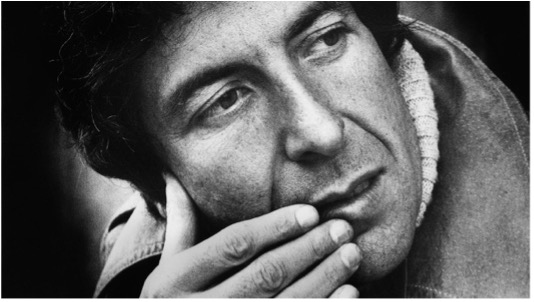
Leonard Cohen died on the 7th of November 2016, and in the days following his death there was a flood of obituary pieces celebrating his life and art. My contribution was posted on social media a few days later, as a personal reflection on the man and the music that has been an integral part of my life for over 40 years. The reaction to the post ranged from one theologian saying that it was the best thing he had read on Cohen, and someone else saying that I had gone “off the rails” and was no longer a Christian. I offer the article here and will leave you to decide for yourself.
In a world of vacuous, meaningless pop music, Cohen towered above the competition, and few could match the lyrical and emotional depth of his work. Although he never achieved major commercial success, other artists regularly reference him as a major influence and his much-covered song Hallelujah has become one of the best-known songs of the 21st Century. Cohen managed to avoid the long, slow slide into mediocrity common to many ageing artists, his last three albums are amongst his best and they reveal him to have been at the peak of his art when he died.
Cohen is not a figure that Christians might naturally gravitate towards as a source of spiritual insight and in fact his life seems to be a blend of religious contradictions. Born in Montreal to a middle-class Jewish family, he was well instructed in the Torah; his maternal grandfather was a respected Rabbi (Leonard loved the Scriptures, especially Isaiah and the Psalms). He also spent 5 years in a Zen monastery, becoming a Zen priest. His work is infused not only with biblical references but also have a strong focus on sexuality, a subject not widely used as an inspirational source by Christian songwriters.His work has an honest, raw earthiness and often expresses doubt and anger at God in a way that many Christians would at least find uncomfortable if not objectionable.
Yet the themes of Cohen’s art (tradition, calling, desire, brokenness, redemption) are the themes of Scripture. Although he would have most likely rejected the comparison out of personal modesty and reverence for the Psalms,Cohen is really just following in the footsteps of the psalmists by expressing his anger and his doubts and his brokenness. By asking his questions Cohen artfully expresses the broken reality of the human experience, the brokenness of the human heart and ultimately our longing for healing and redemption.
Many of Cohen’s songs feel like prayers, especially the songs on Various Positions, released about the same time he published a book of prayers, ‘Book of Mercy’. In an interview he was asked if he had found in prayer a language that felt natural to him, to which he responded:
“I was touched as a child by the music and the kind of charged speech that I heard in the synagogue, where everything was important…I always feel that the world was created through words, through speech in our tradition, and I’ve always seen the enormous light in charged speech, and that’s what I’ve tried to get to…That is where I squarely stand.” [1]
God’s name is central to Cohen’s tradition and a number of his songs magnify the Name, which has an inherent power, a holiness that comes from the very presence of God as creator and judge. In prayer 15 in the Book of Mercy, Cohen writes that when we call upon the Name, we are as beggars, before the Holy One:
“How beautiful our heritage to have this way of speaking to eternity, how bountiful this solitude, surrounded, filled, and mastered by the Name, from which all things arise in splendour, depending one upon the other.”
Linked to his acknowledgement of the power of the Name and standing before his mercy is an ever-present sense of the reality of the Law (Torah) and human sinfulness. In fact, when asked what profession he would list in an application he is reported to have said “sinner”. For Cohen, a central truth of reality was that the Torah offered a way of living that is rooted in justice and accountability and includes a call to righteousness and the expectation of coming judgement, as expressed in Tower of Song. His time in the Zen monastery on Mt Baldy was not a rejection of his Jewish heritage (Zen Buddhism has no dogma or teaching, it is not a system of belief), rather it afforded him the opportunity to deeply reflect on his faith tradition. In Book of Mercy, he describes the Torah singing to him, touching his hair, and giving him the gift of a crown that lifts the weight of his days till he can sing of how precious this heritage is, asking that the Lord lead him into the Sabbath.
Cohen always had a strong sense of having been chosen for his work. The closing song of Various Positions is the beautifully haunting If it Be Your Will:
If it be your will, that I speak no more
And my voice be still, as it was before
I will speak no more, I shall abide until
I am spoken for, if it be your will
If it be your will, that a voice be true
From this broken hill, I will sing to you
From this broken hill, all your praises they shall ring
If it be your will, to let me sing
If it be your will, if there is a choice
Let the rivers fill, let the hills rejoice
Let your mercy spill, on all these burning hearts in hell
If it be your will to make us well
And draw us near, and bind us tight
All your children here, in their rags of light
In our rags of light, all dressed to kill
And end this night, if it be your will.
According to Cohen’s biographer the song is borrowed from the Kol Nidre service that closes Yom Kippur. Just before the recounting of sins, the Cantor cries: “May it therefore be your will, Lord our God, and God of our Fathers, to forgive us all our sins, to pardon all our iniquities, to grant us atonement for all our transgressions.” Even the melody is derived from the ancient form of synagogue song for this service. In prayer 10 in Book of Mercy Cohen gives thanks that God has “placed me in this mystery and you let me sing.” The profound sense of humility he has always exhibited regarding his art stems from this sense of calling that he has been lifted up and allowed to sing.
Desire and spirituality are always intertwined, and both infuse Cohen’s art with a relentless energy. Cohen was of the view that to separate sex and God would be detrimental to both:
“If God is left out of sex it becomes pornographic; of sex is left out of God, spirituality becomes self-righteous and pious.” [2]
On Various Positions, the song Coming Back to You portrays the complex feelings of longing and desire, of displaced desire and looking for love in the wrong places. The song Dance me to the end of Love inspired by the story of string quartet forced to play beside the crematoria of the Nazi death camps ultimately calls for God in the midst of the torn brokenness of human desire and experience knowing that God’s love is the only love that ultimately satisfies in the midst of and beyond our brokenness. It is that brokenness, the brokenness of human life and the desire that God would restore broken people to wholeness that is perhaps the most dominant theme of Cohen’s work. It is through expressing the pain, of his own brokenness and his doubts and faith, that Leonard seeks to draw himself closer to God, [3] consider this quote from Book of Mercy:
“All my life is broken unto you, and all my glory soiled unto you. Do not let the spark of my soul go out in the even sadness. Let me raise the brokenness to you, to the world where the breaking is for love.” [4]
Above all, Cohen’s work reminds us that we are broken, but that we must bring the whole heap of our brokenness before God.
[5] Commenting on this theme in his song Hallelujah, Cohen said:
“I wanted to write something in the tradition of the hallelujah choruses but from a different point of view…it’s the notion that there’s no perfection – that this is a broken world and we live with broken hearts and broken lives but still that is no alibi for anything. On the contrary, you have to stand up and say hallelujah under those circumstances.” [6]
Cohen’s last three albums continued to explore those themes with a clearer focus on the mercy and redemption of God, consider Come Healing from Old Ideas:
O gather up the brokenness and bring it to me now
The fragrance of those promises you never dared to vow
The splinters that you carry, the cross you left behind
Come healing of the body. Come healing of the mind
And let the heavens hear it, the penitential hymn
Come healing of the spirit. Come healing of the limb
Behold the gates of mercy, in arbitrary space
And none of us deserving, the cruelty or the grace
O solitude of longing, where love has been confined
Come healing of the body. Come healing of the mind
O see the darkness yielding, that tore the light apart
Come healing of the reason. Come healing of the heart
O troubled dust concealing an undivided love
The heart beneath is teaching, to the broken heart above
Let the heavens falter. Let the earth proclaim
Come healing of the altar. Come healing of the name
O longing of the branches, to lift the little bud
O longing of the arteries, to purify the blood
And let the heavens hear it, the penitential hymn
Come healing of the spirit. Come healing of the limb
O let the heavens hear it, the penitential hymn
Come healing of the spirit. Come healing of the limb
The mystery of our brokenness and God’s love is the broken heart of God, who offers mercy and healing to the penitent.
Although Cohen has been variously labelled as the patron saint of depressed students all alone in their bedsits, and the master of depression etc. his work is also infused with deep warmth, love and feeling and an acute understanding of the human condition and need for God. As one reviewer noted regarding Old Ideas, you can divide the songs on this album into two categories: hymns (songs of praise) and elegies (songs of mourning) [7], a comment that could be true of his whole body of work. His final album You Want it Darker is one of his greatest works; the title track appropriates the Kaddish, a traditional mourner’s prayer in Judaism:
Glorified and sanctified be God’s great name throughout the world which He has created according to His will.
May He establish His kingdom in your lifetime and during your days,
and within the life of the entire House of Israel, speedily and soon; and say, Amen.
May His great name be blessed forever and to all eternity.
Blessed and praised, glorified and exalted, extolled and honoured, adored and lauded be the name of the Holy One, blessed be He, beyond all the blessings and hymns, praises and consolations that are ever spoken in the world; and say, Amen.
May there be abundant peace from heaven, and life, for us and for all Israel; and say, Amen.
He who creates peace in His celestial heights, may He create peace for us and for all Israel; and say, Amen.
It reveals a man who at 82 had come to terms with himself, with his life and was ready to die. Months earlier he had written to his muse Marianne as she lay dying telling her that he was not far behind. Yet the album reflects no fear or apprehension, but a calm acceptance, a peaceful readiness. He sings to God:
If you are the dealer, I’m out of the game
If you are the healer, it means I’m broken and lame
If thine is the glory then mine must be the shame.
Here is a man who is as much at peace with his life as he is facing death, he sings:
I don’t need a reason
For what I became
I’ve got these excuses
But they’re tired and lame
I don’t need a pardon
There’s no one left to blame.
Australian theologian/blogger Michael Frost said in his review of the album, “I suppose we all wonder at one time or another how death will come for us, and how we’ll prepare ourselves for our final breath. We’ve seen a hundred movies where heroic characters face their final battle and die gently in the arms of their friends as they utter their last words. No one really dies like that. We die in hospital beds. With catheters and starched sheets and bleeping devices. It’s hard to see it as heroic. And yet there’s something beautifully heroic about this album. Here’s a fragile old man standing up to his full height, acknowledging his foolish ways (“I struggled with some demons / They were middle class and tame”), and bowing his head humbly before God. Cohen once told his fans not to listen to his musings on life, but rather to listen to the mind of God. It’s good advice, but it’s still nice to see a man old enough to be my father showing me how to face death with a prayer on his lips: Magnified, sanctified, be thy holy name /Vilified, crucified, in the human frame.”
I am thankful for Leonard’s life and his art, and I hope that when my time comes, I will face my own death with the same hope, peace, and acceptance, and today I will say Kaddish for Leonard.
[1] Leonard Cohen: “Leonard Cohen as interviewed by Robert Sward” Montreal, Quebec, 1984, www.leonardcohenfiles.com/sward.html.
[2] Christian Scharen, Broken Hallelujahs, (Grand Rapids: Brazos Press, 2011), 42
[3] I think that it was Jaques Ellul who said that with his questions man raises himself up to God.
[4] Leonard Cohen, Book of Mercy, (Ontario: McClelland Stewart, 1984), prayer 49
[5] Leonard Cohen, Leonard, Book of Mercy, (Ontario: McClelland Stewart, 1984), prayer 45
[6] Leonard Cohen in ‘A Master’s Reflection on His Music’ Robert Hilburn Los Angeles Times September 24, 1995
[7] http://www.canadianinterviews.com/reviews/index.php?ID=1052&SECTION=82&type=music